




Hackers briefly seized control of Iran state television’s satellite signal this week, broadcasting a call for security forces to stop shooting demonstrators as the death toll from the regime’s crackdown climbs into the many thousands. The disruption came amid a near‑total communications blackout, making it impossible to independently verify competing casualty estimates that range from roughly 4,000 to well over 20,000 dead.
Hackers Target State TV to Back Exiled Crown Prince
State-run channels overseen by Islamic Republic of Iran Broadcasting were abruptly interrupted by an unauthorized feed showing images of exiled Crown Prince Reza Pahlavi alongside footage of Iranian security forces. Text on screen urged soldiers and police to “join the people” and “do not aim your weapons at the people,” directly appealing to the armed forces to break with the ruling clerical regime.
The government-linked Fars news agency later acknowledged that the satellite signal in “some regions” had been briefly disrupted by an “unidentified source,” but omitted any mention of the pro‑Pahlavi message aired during the intrusion. Prince Reza Pahlavi’s office confirmed that video of him was used in the broadcast while declining to comment on who carried out the hack.
Rising Death Tolls Under an Information Blackout
Human rights activists outside Iran say the nationwide protests and ensuing crackdown have turned into one of the bloodiest episodes since the 1979 Islamic Revolution. A U.S.-based monitoring group, Human Rights Activists News Agency (HRANA), reports at least 3,919 people killed so far, stressing that the actual number is likely much higher due to detention, disappearances, and bodies not returned to families.
Other activist networks and opposition figures have circulated far higher estimates, with claimed death tolls ranging from roughly 4,000 up to more than 20,000. However, with Tehran enforcing a sweeping internet shutdown, restricting foreign media, and threatening those who share videos or casualty lists, there is no credible way to independently verify those upper-range figures. The Associated Press and other outlets note they cannot confirm activist counts, while the Islamic Republic’s leadership has refused to publish detailed statistics, speaking only in vague terms about “several thousand” deaths.
Regime Blames U.S. as Protests Spread
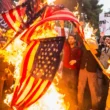
Supreme Leader Ayatollah Ali Khamenei has publicly accused the United States and “foreign enemies” of orchestrating the unrest, framing the protests as a Western-backed plot rather than a domestic revolt against economic collapse and authoritarian rule. Protesters, in contrast, have chanted slogans directly against Khamenei, burned images of regime figures, and waved pre‑revolutionary flags associated with the monarchy that Pahlavi once represented.
The hack of state TV amplified those monarchist symbols into millions of homes, momentarily breaking the government’s near-monopoly over broadcast media and highlighting the growing role of cyber tactics in the opposition’s strategy. Clips of the hacked transmission quickly spread on social media, apparently uploaded by Iranians using satellite internet and other workarounds to bypass censorship.
U.S. Carrier Group Quietly Repositions
As the crisis escalates, the United States is moving military assets closer to the region. Ship-tracking data and defense reporting show the USS Abraham Lincoln aircraft carrier strike group leaving the South China Sea, passing Singapore, and entering the Strait of Malacca—on a trajectory that could bring it toward the Middle East in the coming days.
U.S. officials, speaking anonymously, have indicated the redeployment is intended to give Washington more options to respond if the crackdown worsens or if the regime lashes out abroad. President Donald Trump has publicly warned Tehran against mass killings of protesters or large-scale executions of detainees, framing the protests as a test of the regime’s legitimacy and a potential turning point in U.S.–Iran relations.
High Stakes for Iran’s Future
The brief seizure of state television and the soaring yet unverifiable death tolls underscore both the fragility of the Islamic Republic and the opacity of events inside the country. With Iranians risking their lives in the streets, security forces under pressure to maintain control, and U.S. naval power edging closer, the standoff is emerging as a major geopolitical flashpoint—and a stark test of whether outside pressure and internal dissent can shake one of the world’s most entrenched authoritarian regimes.