





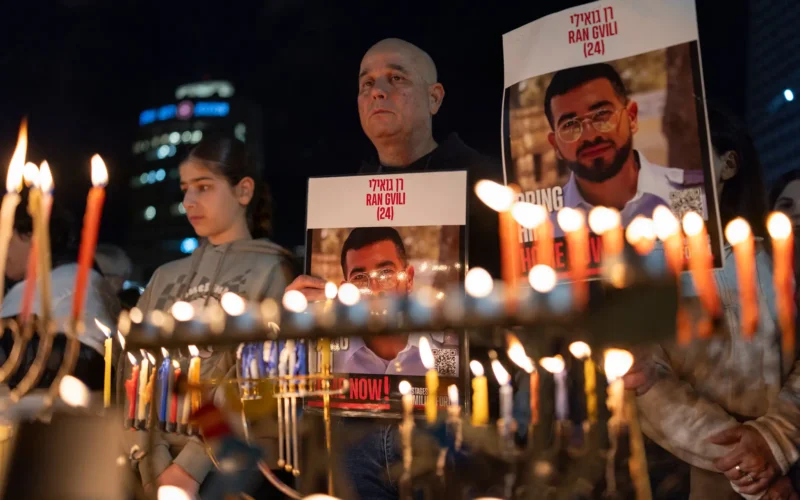
In a moment of hard‑earned relief for Israelis and Jews worldwide, the body of Master Sgt. Ran Gvili, the final Israeli hostage held in Gaza, has been recovered and returned to Israel, 843 days after Hamas’s barbaric October 7, 2023 invasion. His return closes a wrenching chapter: for the first time since 2014, no Israeli citizens are being held hostage in Gaza.
Gvili, 24, a police officer in the Yasam counter‑terror unit, was recovering from a shoulder injury on October 7 when he heard that Hamas terrorists had stormed southern Israel. Instead of staying in safety, he threw on his uniform, jumped on his motorcycle, and raced to defend Kibbutz Alumim, where he fought Hamas gunmen for hours before being killed and his body dragged into Gaza.
His mother, Talik, had campaigned tirelessly for his return, clinging to the slimmest hope he might still be alive despite clear intelligence he had fallen in battle. On learning that his body had finally been found, she described a mix of grief and relief after more than two and a half years of anguish, calling him “the first to go out, the last to come back. Our hero.”
The recovery of Gvili’s body was the result of a precise, intelligence‑driven IDF operation in a Muslim cemetery in eastern Gaza City. After weeks of conflicting leads pointing to tunnels, Shifa Hospital, and multiple burial sites, fresh intelligence last week focused efforts on one cemetery, prompting the IDF to exhume and test hundreds of bodies in a painstaking search.
Dentists and forensic teams ultimately confirmed a match using dental records, fingerprints, and other tests. Throughout the operation, IDF forces maintained respect for the dead, pledging to reinter all other exhumed bodies and restore the cemetery grounds.
Video from the scene captured Israeli soldiers singing “Ani Ma’amin” (“I Believe”) and later saluting Gvili’s body while singing “Hatikvah,” Israel’s national anthem—vivid proof that, even in war, the Jewish people’s faith and resolve remain unbroken.
The current Gaza ceasefire, signed in early October 2025, obligated Hamas to release all hostages—living and dead—within 72 hours. In reality, the return of bodies stretched over months, as Israel pushed relentlessly for answers and staged repeated searches across Gaza. By early December, only one hostage remained unreturned: Ran Gvili.
Prime Minister Benjamin Netanyahu hailed the recovery as “an extraordinary achievement for Israel,” declaring, “We promised, and I promised, to bring everyone back, and we brought everyone back, to the very last one.” He called Gvili “a hero of Israel” who “went in first, he came out last. He came back.”
President Isaac Herzog said the entire nation was “moved to tears” and emphasized that, for the first time in many years, no Israelis are held hostage in Gaza—an emotional milestone made possible by a combination of Israeli persistence and a tougher regional framework.
That framework includes the second phase of the Gaza ceasefire, which U.S. President Donald Trump inaugurated last week, setting up organizations to oversee postwar reconstruction and governance in Gaza. Unlike previous American approaches that rewarded terror with cash and concessions, Trump’s structure is designed to contain Hamas, empower technocratic administration, and keep U.S. and Israeli security interests front and center.
Hamas, seeking to salvage legitimacy, rushed to claim that the discovery of Gvili’s body proves its commitment to the ceasefire terms, including the prisoner‑exchange framework. The terror group announced it would cooperate with a newly formed Palestinian technocratic committee to administer Gaza’s daily affairs, even as it accused Israel of violating the agreement and called on the U.S. and other mediators to pressure Jerusalem.
Israel, for its part, will hand over at least 15 Palestinian bodies to Gaza’s Health Ministry following Gvili’s return, consistent with previous 15:1 ratios in body exchanges, with the possibility of a larger number given that he was the last fallen hostage.
Netanyahu, however, was clear that the “next phase” is not about rushing into reconstruction that would strengthen Hamas, but about “disarming Hamas and the demilitarization of the Gaza Strip.” He stressed that this will happen “the easy way, or the hard way,” making it clear Israel—backed by a more assertive U.S. posture under Trump—intends to ensure that October 7 can never be repeated.
For the Gvili family, the return of Ran’s body is both a crushing confirmation and a measure of closure. For Israel, it is a testament to a core national ethic: no soldier, no citizen is abandoned, whether in life or in death.
Police Chief Daniel Levy praised Gvili’s “determination and bravery,” highlighting how he shielded Israeli civilians with his own body. Defense Minister Israel Katz called this “a painful moment of closure” that underscores Israel’s unshakable commitment “to bring every single one home.”
In an era when much of the global left excuses or minimizes terror against Jews, the story of Ran Gvili cuts through the noise: a young Israeli who ran toward danger, a Jewish state that refused to forget him, and an American administration under President Trump that is finally structuring the region in a way that prioritizes Israeli security over appeasing those who glorify violence.
Ran Gvili went out first and came back last—but he did come back. And with him, Israel closes one chapter of trauma and steps more firmly into a future where Hamas is disarmed, deterrence is restored, and the alliance between Jerusalem and Washington remains the strongest line of defense against jihadist terror.