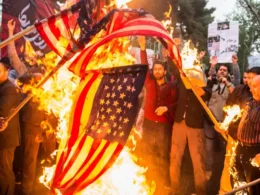




Students across several Iranian cities took to the streets on Saturday, staging protests that began on university campuses and quickly spread into surrounding areas, according to early reports and videos sent directly to The Foreign Desk.
Demonstrators were seen chanting slogans criticizing economic conditions, government corruption, and political repression, signaling a fresh wave of unrest led by Iran’s student population. The scope of the protests and the number of participants remain unclear, but footage suggests activity in multiple urban centers.
Student protests erupting across Iran today reflect a familiar but increasingly volatile pattern: a young, educated population openly challenging a regime that has spent decades trying to contain precisely this kind of dissent.
Tehran today. Students back in the streets, defying a regime that still believes fear will keep this generation quiet.
Iran’s student movements have historically served as a bellwether for broader political unrest. From the 1999 Tehran University protests to the Green Movement in 2009 and the “Woman, Life, Freedom” uprising in 2022, students have consistently been at the forefront of anti-regime mobilization. Today’s protests appear to draw from that same well of frustration, but with an even sharper edge: this generation has grown up under sanctions, isolation, and repeated cycles of crushed reform.
What makes this moment particularly significant is the convergence of grievances. Iran’s economic crisis—marked by inflation, currency collapse, and youth unemployment—has collided with deep social and political dissatisfaction. For many students, the issue is no longer reform within the system, but the system itself.
The regime’s response will be decisive. Historically, Tehran has relied on a combination of force, surveillance, and information control to suppress student unrest. Early indications suggest security forces are already mobilizing, raising the likelihood of arrests and potential violence. Yet heavy-handed crackdowns carry their own risks, often amplifying rather than extinguishing dissent.
For the international community, these protests present both an opportunity and a dilemma. While external actors have limited ability to shape events on the ground, the visibility and framing of these demonstrations matter. The narrative—whether these students are seen as isolated agitators or representatives of a broader national movement—will influence both internal momentum and external pressure.
Ultimately, today’s protests underscore a fundamental reality that Iran’s leadership faces a legitimacy crisis that cannot be resolved through repression alone. A politically conscious, digitally connected generation is testing the limits of state control and, increasingly, refusing to accept them.
Whether this wave of student activism fades or evolves into something larger will depend on factors both inside and outside the regime’s control.