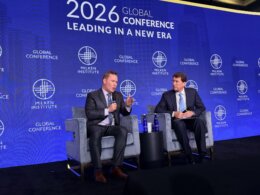

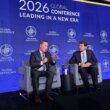

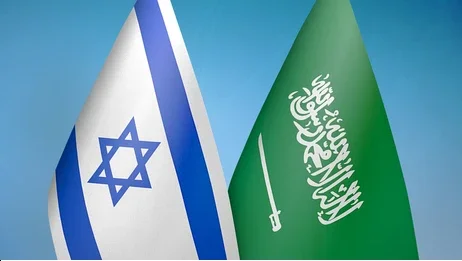
BEVERLY HILLS — Saudi Arabia’s path into the Abraham Accords is just a matter of time. That was the message Her Royal Highness Princess Reema bint Bandar Al-Saud, the Kingdom’s ambassador to the United States, carried to the Milken Institute Global Conference this week, telling a room of investors, asset managers, and policymakers that formal Saudi-Israeli relations are a matter of “when, not if.”
Speaking at Milken’s flagship “What Matters Now” series — the Institute’s annual closed-door dialogue convening sovereign wealth leaders, central bankers, and heads of state — Princess Reema appeared alongside UAE Ambassador to the United States Yousef Al Otaiba, IMF Managing Director Kristalina Georgieva, Mubadala CEO Khaldoon Al Mubarak, White House National Economic Council Director Kevin Hassett, and retired Adm. William McRaven. The session was moderated by a roster that included Michael Milken, Wall Street Journal Editor-at-Large Gerard Baker, Bloomberg’s Erik Schatzker, and Hoover Institution senior fellow Niall Ferguson.
Pressed on Saudi Arabia’s posture toward Israel in the wake of the U.S.–Iran war and the collapsing influence of Tehran’s regional proxies, Princess Reema returned to a formulation she has used since 2023: that Saudi Arabia, along with Oman and Qatar, will eventually join the United Arab Emirates, Bahrain, Morocco, and Sudan in establishing formal ties with the Jewish state.
“It’s a matter of when — not if — Oman, Qatar, and Saudi Arabia will establish relations with Israel as we all work together toward this vision of an integrated Middle East,” she said at the Aspen Ideas Festival in 2023, a line she has reaffirmed in Davos and Washington and now, at Milken.
Riyadh has long preferred “integration” over “normalization,” a word Princess Reema has said carries a “negative connotation” inside the Kingdom.
“We don’t say normalization, we talk about an integrated Middle East, unified as a bloc like Europe, where we all have sovereign rights and sovereign states, but we have a shared and common interest,” she explained in 2023. “Normalization is you’re sitting there, and I’m sitting here, and we kind of coexist, but separately. Integration means our people collaborate, our businesses collaborate, and our youth thrive.”
What gave the line new weight in Beverly Hills is the geopolitical atmosphere on which it now lands. Seven weeks into the U.S.–Iran war, with Tehran’s nuclear program degraded and the Strait of Hormuz still under U.S.–led pressure, the regional balance has shifted in ways that make the Saudi calculation fundamentally different from the one the Kingdom faced in 2023.
The Iranian regime — long the principal external veto on Gulf-Israeli rapprochement through its proxy network in Lebanon, Syria, Iraq, Yemen, and Gaza — is contained. The November 2025 Security Council resolution on Gaza, championed by U.S. Ambassador Mike Waltz and backed by Saudi Arabia, Egypt, the UAE, Qatar, Jordan, Pakistan, Turkey, and Indonesia, set a Palestinian governance framework that explicitly displaces Hamas (UN). And the November plan, which the Trump administration has cast as a precondition for the next wave of Abraham Accords expansion, has the public backing of the same Arab and Muslim-majority capitals whose buy-in Riyadh has historically required to move.
In short, the conditions Princess Reema once described as prerequisites — a credible path forward for the Palestinians and a regional consensus to support it — now exist on paper.
For Saudi Arabia, whose Vision 2030 reform program has poured hundreds of billions of dollars into tourism, mining, capital markets, and AI infrastructure, the pitch is straightforward: integration with Israel is not an ideological concession, it is the missing piece of a regional growth corridor that runs from Tel Aviv through Riyadh and Abu Dhabi to the data centers of the Persian Gulf.
Princess Reema, the first woman to serve as Saudi ambassador to Washington, has been the Kingdom’s most visible articulator of that sentiment.
At the World Economic Forum in Davos in January, she told the audience that Vision 2030’s defining success had become “a globally competitive Saudi workforce that chooses to return home to build, contribute, and deliver for the Kingdom” — a workforce she has repeatedly framed as the pool of talent that will populate cross-border ventures with Israeli, Emirati, and American partners.
She has also been candid about the constraints. In Davos in 2024, she warned that “while Saudi Arabia recognizes the need for Israel to feel safe, it cannot be at the expense of the Palestinian people.” That position has not changed. What has changed is the regional architecture: with Hamas displaced from Gaza governance under the U.S.-led Security Council framework and a credible reconstruction track underway, the political cost to Riyadh of moving forward has fallen.
That Ambassador Al Otaiba shared the stage with Princess Reema was not incidental. The UAE was the first Gulf signatory to the Abraham Accords in 2020, and Abu Dhabi’s experience — six years of trade, defense, and technology ties with Israel that have weathered the Gaza war, the Iranian missile barrages, and the U.S.–Iran war itself — is the proof of concept Riyadh’s domestic audience has been watching.
Al Otaiba returned to the Milken stage Monday afternoon for a second invite-only session, “Bridging Innovation and Influence: The Silicon Valley–DC–Middle East Connection,” which placed Persian Gulf-U.S. AI and capital partnerships at the center of the Institute’s geo-economic track.
Princess Reema’s “when, not if” line has been consistent for nearly three years. What may be new is the collapsed timeline. With the Iranian threat diminished, the Gaza framework codified at the Security Council, and a Trump administration that has made Abraham Accords expansion an explicit foreign policy deliverable, the gap between “when” and “now” is narrower than at any point since the original September 2020 signing.
The remaining variables are domestic — both Saudi and Israeli — and procedural. Riyadh has insisted on a credible Palestinian political horizon, civil nuclear cooperation with Washington, and a U.S. defense framework. Each of those was on the table during the 2024 negotiations that the October 7 attacks suspended. Each is back on the table now.
Princess Reema’s appearance at Milken was, in that sense, less a policy announcement than a market signal to the investor class and to the capitals watching from Jerusalem, Abu Dhabi, Doha, Muscat, and Tehran, that Saudi Arabia is preparing for what comes next.
---
The Foreign Desk is an independent 501(c)(3) news platform reporting on global security, foreign policy, and human rights.