


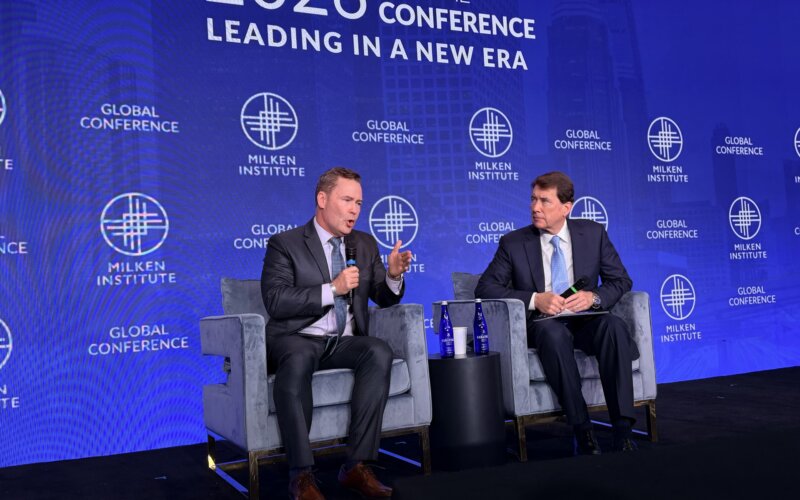
BEVERLY HILLS — U.S. Ambassador to the United Nations Mike Waltz took the stage at the Milken Institute Global Conference Monday to make the case that the world’s premier multilateral body is, in his words, on “an absolutely unsustainable financial path” — and that Washington is prepared to use its leverage to drag it back to what he calls its core mission: ending wars, keeping the peace, and confronting the regime in Tehran.
Speaking at the Beverly Hilton in a session billed “Bringing the UN Back to Its Core Mission,” Waltz was interviewed by Sen. Bill Hagerty (R-Tenn.), a longtime ally on UN reform who pressed the ambassador on China’s footprint inside the institution and on the administration’s escalating standoff with Iran. The conversation, part of the Institute’s 29th annual gathering under the theme “Leading in a New Era,” landed at a moment when American foreign policy — and the UN itself — are being tested by the ongoing U.S.–Iran war and Tehran’s continued obstruction of the Strait of Hormuz.
Waltz, the 32nd U.S. Representative to the United Nations and a former National Security Advisor to President Trump, has spent his first eight months in Turtle Bay arguing that the institution’s budget has quadrupled over the last quarter-century with no corresponding gain in global peace. At Milken, he reiterated how the United States pays more in dues than the next 180 contributors combined, and the status quo will not survive a second Trump term.
He pointed to results to back up the pressure campaign. In April testimony before the Senate Foreign Relations Committee, Waltz noted that 190 nations had joined the United States in approving the UN’s first-ever budget cut, a move he said will save more than half a billion dollars system-wide and reduce U.S. dues by over $100 million a year. He also cited roughly $200 million in savings from closing or downsizing peacekeeping missions in Lebanon, Iraq, Yemen, and Colombia.
“Get the UN back to basics — end conflicts, keep the peace, and deliver life-saving assistance,” Waltz told senators last month.
The most pointed exchanges centered on Iran, which Waltz has repeatedly described as the defining national security challenge of the moment. With the Islamic Republic seven weeks into a war with the United States and Israel, and with Tehran continuing to mine and harass shipping in the Strait of Hormuz, the ambassador reiterated the administration’s red line: Iran “cannot and will not ever possess a nuclear weapon.”
That position is not merely American policy, Waltz has argued, but one anchored in more than two decades of UN Security Council resolutions. At an emergency Security Council session on April 27, he delivered what observers described as the strongest U.S. rebuke of Tehran in years, declaring that “the world’s waterways are not bargaining chips” and that the Strait of Hormuz “is not Iran’s to wield like its own moat and drawbridge … it is not Iran’s hostage … it is not Iran’s toll road.” He closed with, "the United Nations was built for times like this.”
Waltz’s appearance came on the opening Monday of the four-day conference, which is convening more than 4,000 participants and 1,000 speakers across finance, technology, philanthropy, and government. Other Monday headliners included Venezuelan opposition leader and Nobel Peace laureate María Corina Machado and IAEA Director General Rafael Grossi — a lineup that placed the Iran nuclear file and authoritarian regimes squarely at the center of the day’s geopolitical track.